 Add to Chrome
 Add to Firefox
 Add to Edge
Scaling Multi-Node Mixture-of-Experts Inference Using Expert Activation Patterns
Apr 25, 2026
Most recent state-of-the-art (SOTA) large language models (LLMs) use Mixture-of-Experts (MoE) architectures to scale model capacity without proportional per-token compute, enabling higher-quality outputs at manageable serving costs. However, MoE inference at scale is fundamentally bottlenecked by expert load imbalance and inefficient token routing, especially in multi-node deployments where tokens are not guaranteed to be routed to local experts, resulting in significant inter-node all-to-all communication overhead. To systematically characterize these challenges, we profile SOTA open-source MoE models, including Llama 4 Maverick, DeepSeek V3-671B, and Qwen3-230B-A22B, on various datasets and collected over 100k real expert activation traces. Upon studying the expert activation patterns, we uncover various persistent properties across all the frontier MoE models: variable expert load imbalance, domain-specific expert activation where expert popularity shifts across task families (code, math, chat, general), and a strong correlation between prefill and decode expert activations. Motivated by these findings, we propose workload-aware micro-batch grouping and an expert placement strategy to maximize token locality to the destination expert, thereby reducing inter-node communication. Across models and datasets, these optimizations help reduce all2all communication data up to 20, resulting in lower MoE decode latency and better accelerator utilization.

Demystifying Platform Requirements for Diverse LLM Inference Use Cases
Jun 03, 2024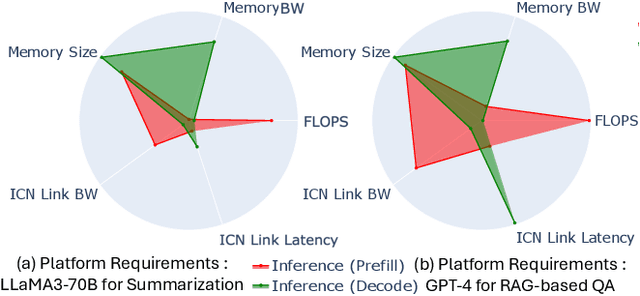
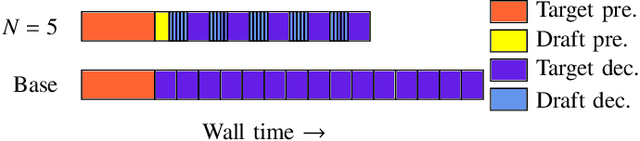
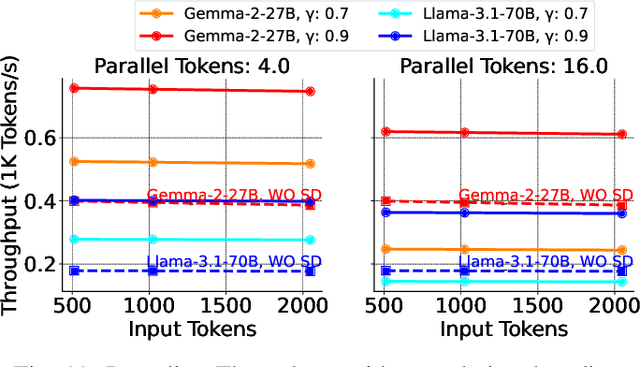
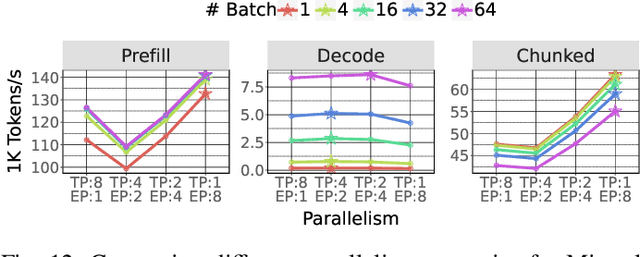
Large language models (LLMs) have shown remarkable performance across a wide range of applications, often outperforming human experts. However, deploying these parameter-heavy models efficiently for diverse inference use cases requires carefully designed hardware platforms with ample computing, memory, and network resources. With LLM deployment scenarios and models evolving at breakneck speed, the hardware requirements to meet SLOs remains an open research question. In this work, we present an analytical tool, GenZ, to study the relationship between LLM inference performance and various platform design parameters. Our analysis provides insights into configuring platforms for different LLM workloads and use cases. We quantify the platform requirements to support SOTA LLMs models like LLaMA and GPT-4 under diverse serving settings. Furthermore, we project the hardware capabilities needed to enable future LLMs potentially exceeding hundreds of trillions of parameters. The trends and insights derived from GenZ can guide AI engineers deploying LLMs as well as computer architects designing next-generation hardware accelerators and platforms. Ultimately, this work sheds light on the platform design considerations for unlocking the full potential of large language models across a spectrum of applications. The source code is available at https://github.com/abhibambhaniya/GenZ-LLM-Analyzer .